Allophylus serratus
Sapindaceae
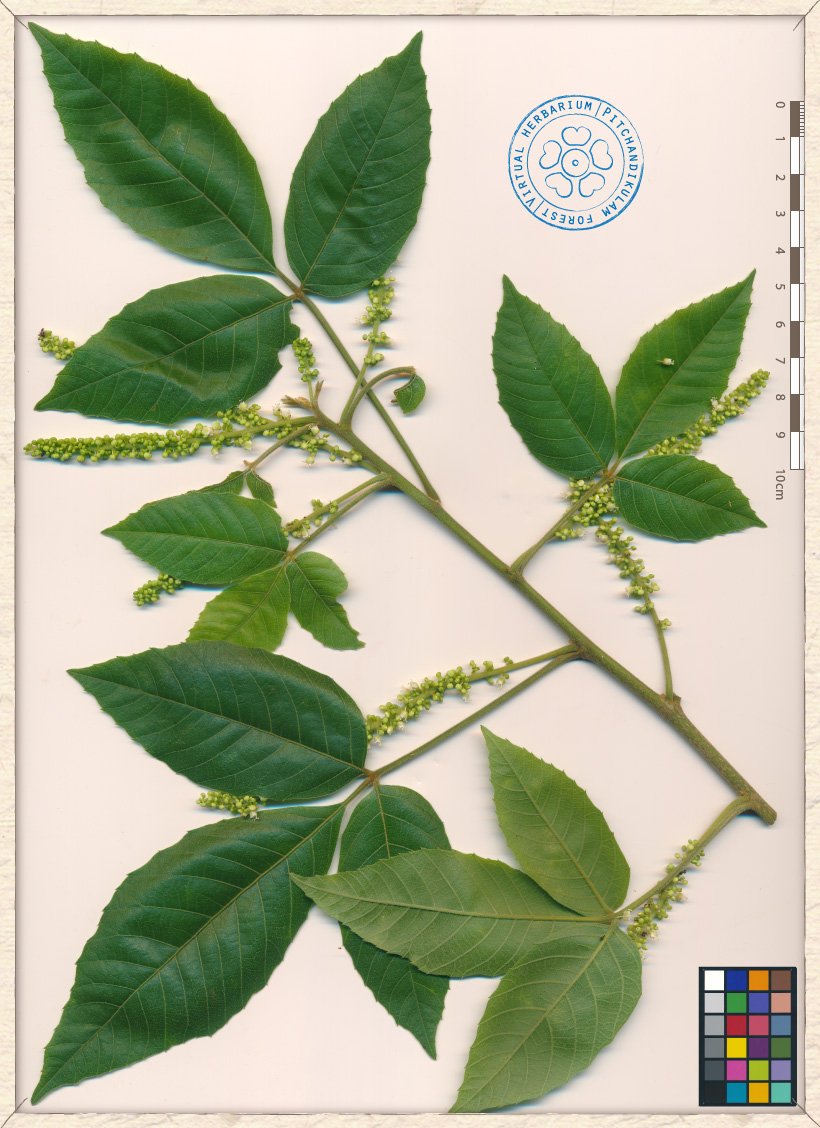
Main specimen
Habit
Allophylus serratus is a thornless and deciduous shrub growing up to 6-8 m high.

Allophylus serratus shrubs

Allophylus serratus shrub

Allophylus serratus shrub
Stem Bark
The bark of Allophylus serratus is light-brown-coloured and longitudinally fissured.

Allophylus serratus trunk

Allophylus serratus bark

Allophylus serratus young stem
Leaf
The leaves of Allophylus serratus grow alternately on the stem (spirally arranged).
The leaf is compound, trifoliate with a 4-7 cm long petiole.
The leaflets are dark green-coloured above and paler beneath. The leaflets are chartaceous and pubescent on both sides.
The lateral leaflets have a very short petiolule and the terminal leaflet has a 1 cm long petiolule.
The lateral leaflets of Allophylus serratus are 5-8 cm long and 3-4 cm wide, ovate-lanceolate with an acuminate apex and an oblique and rounded base.
The terminal leaflet of Allophylus serratus are 7-12 cm long and 3.5-4.5 cm wide, elliptic with an acuminate apex and an attenuated base.
The margins of the leaflets are serrate.
The venation of the leaf is reticulate with a prominent midrib.

Allophylus serratus branchlet

Allophylus serratus leaf (upper side)

Allophylus serratus leaf (lower side)

Allophylus serratus leaflet (upper side)

Allophylus serratus leaflet (lower side)

Allophylus serratus foliage

Allophylus serratus leaf (upper sise)

Allophylus serratus leaf (lower side)
Flower
The flowers of Allophylus serratus are grouped in axillary racemes (at the upper axils of the leaves). The peduncle is 1-1.5 cm long.
The male and hermaphrodite flowers are separated on the same inflorescence.
The calyx-lobes are 4, elliptic and imbricate, about 1 mm long and 1 mm wide. The calyx is light green and glabrous.
The corolla is composed of 4 pale yellow-coloured and glabrous petals. The petals are obovate or elliptic, 1.5 mm long and 1 mm wide.
The male flowers have 8 stamens.
The bisexual flowers have a 2-lobed ovary and one style with a bifid stigma.
The flowers are fragrant.

Allophylus serratus blooming twig

Allophylus serratus inflorescences

Allophylus serratus raceme

Allophylus serratus inflorescence in bud

Allophylus serratus in bloom

Allophylus serratus inflorescences

Allophylus serratus flowers and buds

Allophylus serratus flowers

Allophylus serratus flower buds
Fruit
The fruit of Allophylus serratus is a globose drupe. The fruit is globose, 0.5-0.8 cm across, green turning yellowish and red-coloured when ripe. It contains one stone.

Allophylus serratus fruits : ripe (left side) and unripe (right side)

Allophylus serratus unripe fruits

Allophylus serratus unripe fruits

Allophylus serratus unripe fruits

Allophylus serratus unripe fruits
Seed
The seed of Allophylus serratus are inclosed into an ovoid stone. The stone is 5 mm long and 4 mm wide.

Allophylus serratus stones

Allophylus serratus stones
Human Uses
The wood of Allophylus cobbe is hard but not very durable. It used as a timber for temporary structures and indoors.
Source : Useful Tropical Plants Database, Ken Fern, 2014, http://tropical.theferns.info
The raw fruit of Allophylus cobbe is edible, its taste is sour.
Source : Useful Tropical Plants Database, Ken Fern, 2014, http://tropical.theferns.info
The leaf extract of Allophylus cobbe is taken against stomachache.
The leaf paste is applied on scabies.
The root powder mixed with honey is astringent and it is taken for diarrhea.
The fruits are sweet, cooling and tonic.
The whole plant is used on bone fractures, dislocations, inflammations, wounds and ulcers.
Sources :
- Arya Vaidya Sala, 1996, Indian Medicinal plants
- Quattrocchi, 2012, CRC World Dictionary of Medicinal and Poisonous Plants
Ecology
Allophylus cobbe is found in scrub jungles from the coastal plains up to 1500 m high of elevation.
Distribution
Throughout the tropics in South America, Africa and through Asia to Australia and the Pacific.
Source
Information on this page is sourced from: