Asparagus racemosus
No common name set
EditAsparagaceae

Main specimen
Habit
Asparagus racemosus is an armed, woody and deciduous climber growing up to 6-8 m high.

Asparagus racemosus climbing over a tree

Asparagus racemosus climbing over a tree

Asparagus racemosus in bloom
Stem Bark
The bark of Asparagus racemosus is smooth. The climber is armed with stout spines.

Asparagus racemosus stems

Asparagus racemosus thorny stem

Asparagus racemosus thorn

Asparagus racemosus thorns
Leaf
The leaf of Asparagus racemosus is actually a cladode : a leaf-like flattened branch that resembles and functions as a leaf. The cladodes of Asparagus racemosus grow in clusters (4-6 cladodes per cluster). The clusters grow alternately on the stem (spirally arranged).
The cladodes are bright green-coloured and glabrous.
The cladode of Asparagus racemosus is 0.5-1.5 cm long and 0.5-0.8 mm wide. It is linear and falcate, the apex is acuminate, the base is attenuate and the margins are entire.
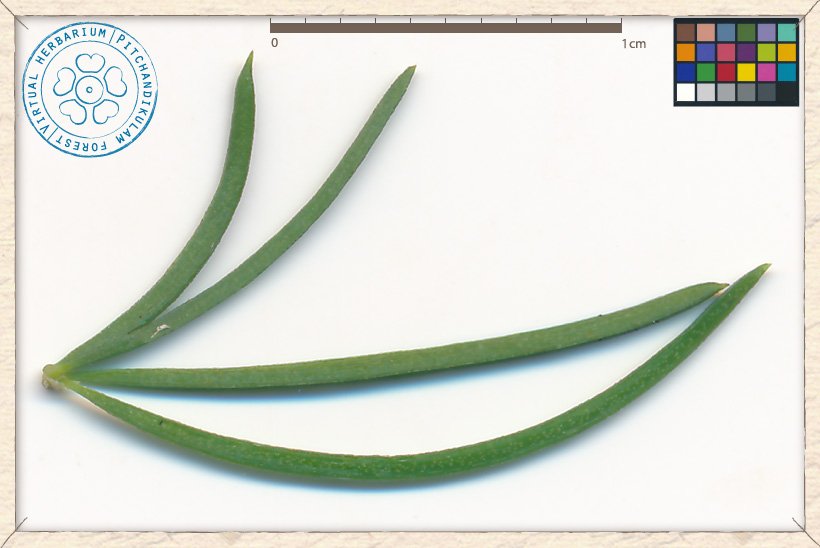
Asparagus racemosus cladodes

Asparagus racemosus cladodes
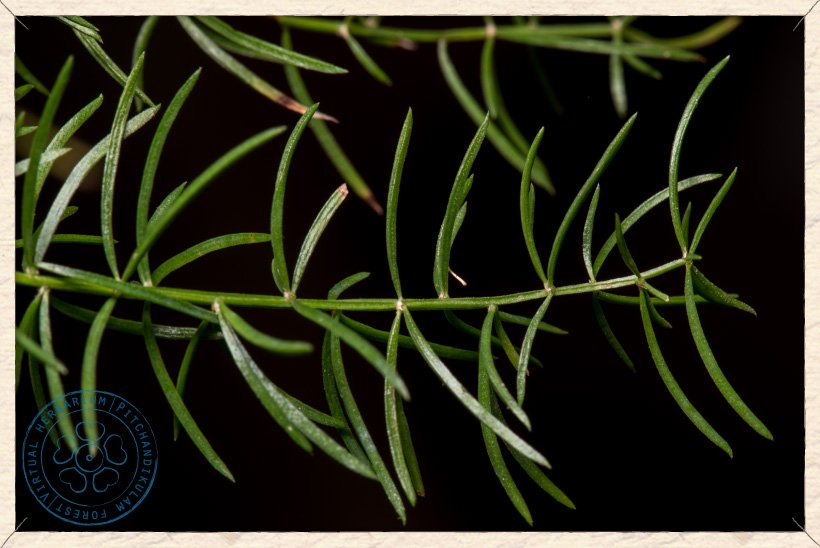
Asparagus racemosus cladodes

Asparagus racemosus branches
Flower
The flowers of Asparagus racemosus are grouped in axillary racemes.
The perianth is composed of 6 tepals. The tepals are obovate, 2.5-3 mm long and 1 mm across. The perianth is white-coloured and glabrous.
The androecium is composed of 6 stamens. The filaments are 2 mm long and white with elliptic and dark brown anthers at the tip.
The style is short (0.5 mm long) with 3 recurved stigmas.
The ovary is subglobose, 1.5 mm across and light green coloured.
The flowers are fragrant.

Asparagus racemosus inflorescences

Asparagus racemosus inflorescence

Asparagus racemosus flowers

Asparagus racemosus inflorescences

Asparagus racemosus inflorescence

Asparagus racemosus flowers

Asparagus racemosus flower buds

Asparagus racemosus in bloom
Fruit
The fruit of Asparagus racemosus is a berry. The fruit is usually 3-lobed and about 1 cm across. The fruit is green ripening red. It contains usually 3 seeds.

Asparagus racemosus unripe fruits

Asparagus racemosus unripe fruit

Asparagus racemosus unripe fruits transversal sections

Asparagus racemosus unripe fruits

Asparagus racemosus unripe fruits

Asparagus racemosus unripe fruits
Human Uses
The boiled roots or root paste of Asparagus racemosus are given to animals to increase secretion of milk.
The roots are given as astringent and vulnerary for diarrhea and dysentery.
The powdered roots mixed with water are applied on wounds of cattle.
Source : Quattrocchi, 2012, CRC World Dictionary of Medicinal and Poisonous Plants
Asparagus racemosus is used in Ayurveda, Unani and Siddha medicines.
The root of Asparagus racemosus is used as a refrigerant, demulcent, diuretic, aphrodisiac, antispasmodic, alterative, anti-diarrhoeatic and anti-dysenteric.
It is generally used as a uterine tonic, in hyperacidity, and as a general health tonic.
The root of Asparagus racemosus is also used for disorders of female genitourinary tract, as a styptic and ulcer-healing agent. The root is used as an intestinal disinfectant and astringent in diarrhoea.
The boiled roots are given to women to increase the secretion of milk.
The powdered tuberous roots mixed with milk are used as a tonic for impotency, quick ejaculation and spermatorrhea.
The tubers are eaten as hepatic stimulant.
The rhizome is chewed and the paste applied on insect bite.
The rhizome extract is given orally as an antiseptic.
The pulp of the ripe fruit is used in eczema.
The tender shoots decoction is used as a tonic for convalescents and as a postpartum remedy.
Along with other therapeutic applications, The Ayurvedic Pharmacopoeia of India indicates the use of the tuberous root in gout, puerperal diseases, lactic disorders, haematuria, bleeding disorders and also recommends it for hyperacidity.
Contact therapy :
A small piece of root is tied around the arm of woman to lead to safe delivery.
A piece of root tied around the ears is used to relieve vertigo and for induction of sleep in children.
Root pieces are tied with a sacred thread as a necklace to cure typhoid.
Sources :
- Arya Vaidya Sala, 1996, Indian Medicinal plants
- Basu & Kirtikar, 1918, Indian Medicinal Plants
- Chopra, 1956, Glossary of Indian medicinal plants
- Khare, 2007, Indian Medicinal Plants, An Illustrated Dictionary
- Quattrocchi, 2012, CRC World Dictionary of Medicinal and Poisonous Plants
Ecology
Asparagus racemosus is common in scrub jungles, thickets, hill slopes and forest borders from the coastal plains up to 1500 m of elevation.
Distribution
Paleotropics
Source
Information on this page is sourced from: