Ficus benghalensis
No common name set
EditMoraceae
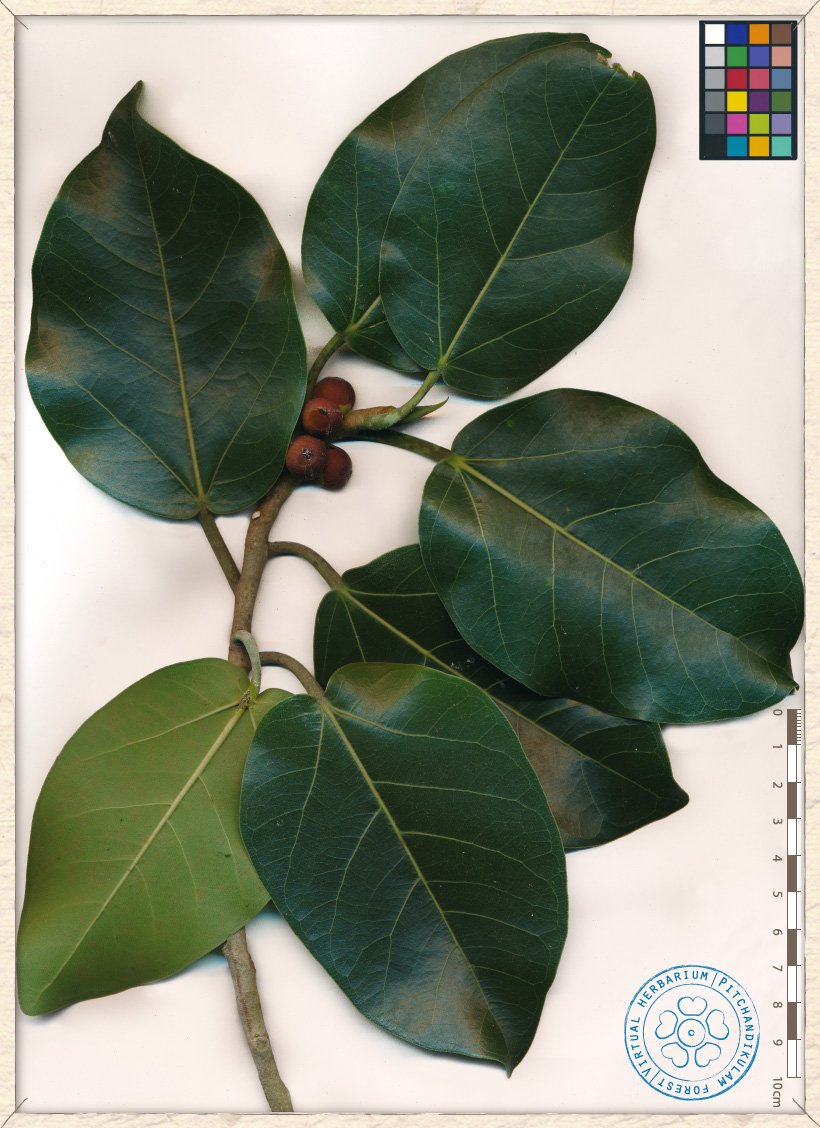
Main specimen
Habit
Ficus benghalensis is a huge spreading and deciduous tree (up to 15 meters).
It has characteristic aerial roots descending from the branches to the ground which over the years grow and become trunk-like pillars supporting the spreading and thick branches. Sometimes, with age, these pillars become indistinguishable from the main trunk.
Some specimens in India are among the largest trees in the world by canopy coverage.
Ficus benghalensis starts its life as an epiphyte (a plant that grows on another plant or object). The seeds germinate in the cracks of a host tree or buildings. The mesh of roots growing around the support tree applies considerable pressure that often kills the host tree.

Ficus benghalensis tree

Ficus benghalensis main trunk and trunk-like pillars supporting the spreading branches

Young Ficus benghalensis strangling a palm tree

The great banyan tree of Kolkata botanic gardens, the largest known in India in spread : more than 250 years old and spreading over an area of about 1.5 hectare with about 2880 prop-roots
Stem Bark
The bark of Ficus benghalenis is greyish-white and smooth (becoming flaky with age). The young shoots are pubescent. The bark exude milky sap when cut.
The aerial roots sending down from the massive horizontal branches become props when reaching the ground and over the years they grow in separate trunks.

main trunk and prop-roots

main trunk

bark
Leaf
The leaves of Ficus benghalensis grow alternately on the stem (spirally arranged), often in clusters at ends of the branches.
The leaves have a pubescent and 2.5-3 cm long petiole.
The leaf is simple, coriaceous and leathery, shiny and dark green coloured above and pale light green coloured below. The upper side of the leaf is glabrous and the lower side is puberulous (especially on the nerves).
The leaf of Ficus benghalensis is 10-15 cm long and 6-9 cm wide. These leaves are ovate, the apex is obtuse to acute, the base is rounded or cordate and the margins are entire.
The venation of the leaf is reticulate with a prominent midrib.
The leaf bud is covered by two large scales that fall when the leaf develops.

branchlet

leaf (upper side)

leaf (lower side)

branchlet

leathery leaves

leaf
Flower
The flowers of Ficus benghalensis are enclosed within a fleshy receptacle referred to as the fig. What we think of as a fruit is an inflorescence, a flower-bearing structure called syconium (*).
The syconium of Ficus benghalensis is monoecious, containing both female and male flowers and also gall flowers (hosts of pollinators).
(*) The syconium is an urn-shaped receptacle which contains between 50 to 7000 (depending on the species) highly simplified uniovulate flowers or florets on its inner surface. It is closed off from most organisms by the ostiole, formed by bracts.
Syconia can be monoecious or functionally dioecious : the former contain female flowers with variable style length and few male flowers, and produce seeds and pollen. The latter have male and female forms in different plants : seed figs contain female flowers with long styles and produce seeds; gall figs contain female flowers with short styles and male flowers and produce pollen.
Once pollinated, the florets develop into achenes or drupes, in which the seeds are enclosed by a layer of endocarp. From this perspective, the fig is an enclosure with tens to thousands of fruits within it. (Galil, J., Fig biology, 1977)

inflorescence : a longitudinal section of the syconium enclosing the flowers

pollinated flowers, the black spot in the middle is a group of wasps (the fig pollinators)
Fruit
The fig, what we referred to as a fruit, is in fact a fleshy enclosure, an infructescence that contains hundreds of tiny fruits (achenes).
The fruits of Ficus benghalensis are globose achenes, brownish and about 2 mm across.
The figs are sessile, in pairs at the axil of the leaves.
They are 1.5-2 cm across, depressed-globose, downy and they are pinkish-red when ripe.

infructescences : the figs

fig

infructescence : a longitudinal section of the fig enclosing the tiny fruits (unripe)

fig enclosing the tiny fruits (ripe)

figs

pair of figs
Human Uses
The latex is externally applied for pains and bruises and in rheumatism and lumbago inflammations. It is applied to the soles of the feet when cracked or inflamed.
The gum is used as a remedy for tooth-ache.
An infusion of the bark is supposed to be a powerful tonic and is considered to have specific properties in the treatment of diabetes.
The leaves are applied, heated as a poultice, to abscesses and wounds for promoting suppuration and they are used to treat allergic conditions of the skin and burning sensations.
The tender ends of the hanging roots are given for obstinate vomiting.
Source : Indian Medicinal Plants, Basu & Kirtikar
- Rasa (taste) : Kashaaya (astringent)
- Guna (quality) : Guru (heavy), ruksha (dry)
- Veerya (potency) : Sheeta (cooling)
- Vipaaka (post-digestive taste) : Katu (pungent)
- Karma (action) : KaphaPittashaamaka (pacifying Kapha and Pitta)
It is Vedanasthaapana (stops the pain), Vranaropana (cures wounds), Raktarodhaka (stopping blood), Shothahara (taking away inflammations and swellings), Chakshushya (pleasing to the eyes).
The latex is used in Vrana (wounds), Vipaadikaa (cracked soles), Sandhishotha (inflammation, swelling of the joints: synovitis, arthritis) Aamavaata (inflammation of the joints: rheumatoid arthritis), Vankshanashotha (swelling in the groin-illiaco-pubic region), Granthishotha (swollen cyst), Karnasraava (exudation from ear), Dantashoola (toothache), Netraabhishyanda (conjunctivitis), Arma (pterigium), also in lymphadenitis, otorrhoea and piles.
The paste of areal roots is applied on the breasts in case of Stanashaithilya (breast looseness), and also in Charmaroga (skin diseases) and skin ulcers.
A bundle of leaves is tied over an inflammatory part or a joint with synovitis.
- Circulatory system : It is Raktashodaka (purifying blood) and Raktapittahara (taking away haemorrhage). In Varnavikaara (diseases of skin complexion), Raktavikaara/Raktapitta (bleeding disorders), a decoction of the tender leaves or the bark is given to drink twice daily. The latex is analgesic (works as pain-killer).
- Digestive system : Being Kashaaya (astringent), it is Stambhana (stopping, making immovable). The latex is given to treat Atisaara (diarrhoea), Raktaatisaara (diarrhoea with blood), Pravaahikaa (amoebic dysentery and bacillary dysentery). In Vibandha (constipation) the tender shoots or tender hanging roots are grounded with the scum of the rice water then mixed with a lassi or sweetened buttermilk and drunk twice daily.
- Reproductive system : Garbhaashayashothahara (removing swelling in the womb). A decoction of the bark or of young shoots is used as a douche in case of Shvetapradara (leucorrhoea) and Raktapradara (menorrhagia). For internal intake, milk and sugar are added to the decoction of young shoots and drunk twice daily (morning and evening). The tender leaves are Garbhasthaapana (anti-abortifacient). Shukrastambhana (arresting, restraining the semen). The latex with sugar is a good remedy to premature ejaculation. The powder of areal roots in water twice daily reduces seminal weakness.
- Respiratory system : A decoction of tender leaves is given in Kaasa (cough with phlegm).
- Urinary system : Mootrasangrahaneeya (to be taken in case of urinary disorders). All latex, bark, skin and fruits are anti-diabetic. The bark soaked in water overnight and drunk the next morning helps to maintain the blood sugar level.
- In fever : Daahaprashaamana (pacifies the burning sensation).
Latex, tender leaves, leaves, bark, fruits, areal roots
Bark/tender leaves decoction : 50-100 ml; Powder : 3-6gr ; latex : 10-20 drops
- On Dosha : Kaphaghna (alleviates Kapha), Pittaghna (alleviates Pitta)
- On Dhatu : Rakta (blood, red blood cells : menorrhagia, complexion enhancer, bleeding disorders), Shukra (gonades : premature ejaculation), Mamsa (muscles) and Meda (adepous tissus) : wound healing
- On Mala : Purisha (stool), Mootra (urine)
- Organs : Uterus (in menorrhagia, leucorrhoea, garbhasthaapana-antiabortifacient)
- Krishnamurthy, K. H., Banyan and Peepul Traditional Family Medicine, Books for all
- Sharma, P. V., 2001, Dravyaguna-Vijana. Chaukhambha Bharati Academy, Varanasi
- Vaidya, V.M. Gogte, 2000, Ayurvedic Pharmacology and Therapeutic Uses of Medicinal Plants (Dravyagunavignyan). Bharatiya Vidya Bhavan
Due to the large size of the tree's canopy Ficus benghalensis provides useful shade in hot climates.
The twigs and leaves make good fodder for cattle but the tree being sacred, its leaves will be plucked for cattle fodder only in the most dire circumstances.
The prop-roots are (or were) used to make tent and poles, cheap furniture, cart yokes and boxes... (the wood of accessory trunks is stronger than that of the main stem).
The wood of Ficus benghalensis is moderately hard but it is durable under water, so it is used for well curbs.
A paper pulp can be prepared from the wood.
The bark and aerial roots yields fibres used for making ropes.
The latex is used for making glue and yields an inferior rubber. This milky sap is also used for copper oxidation.
Source : Useful Plants of India and Pakistan, Dastur
The figs are eaten as a famine fruit.
Ecology
Ficus benghalensis grows in deciduous and semi-evergreen forests, from coastal plains up to 1200 m.
The species tolerates poor soils but it thrives in well-drained, rich soils and sunny places.
Distribution
Ficus benghalensis is native to India, Sri Lanka and Pakistan.
Source
Information on this page is sourced from: