Butea monosperma
No common name set
EditFabaceae
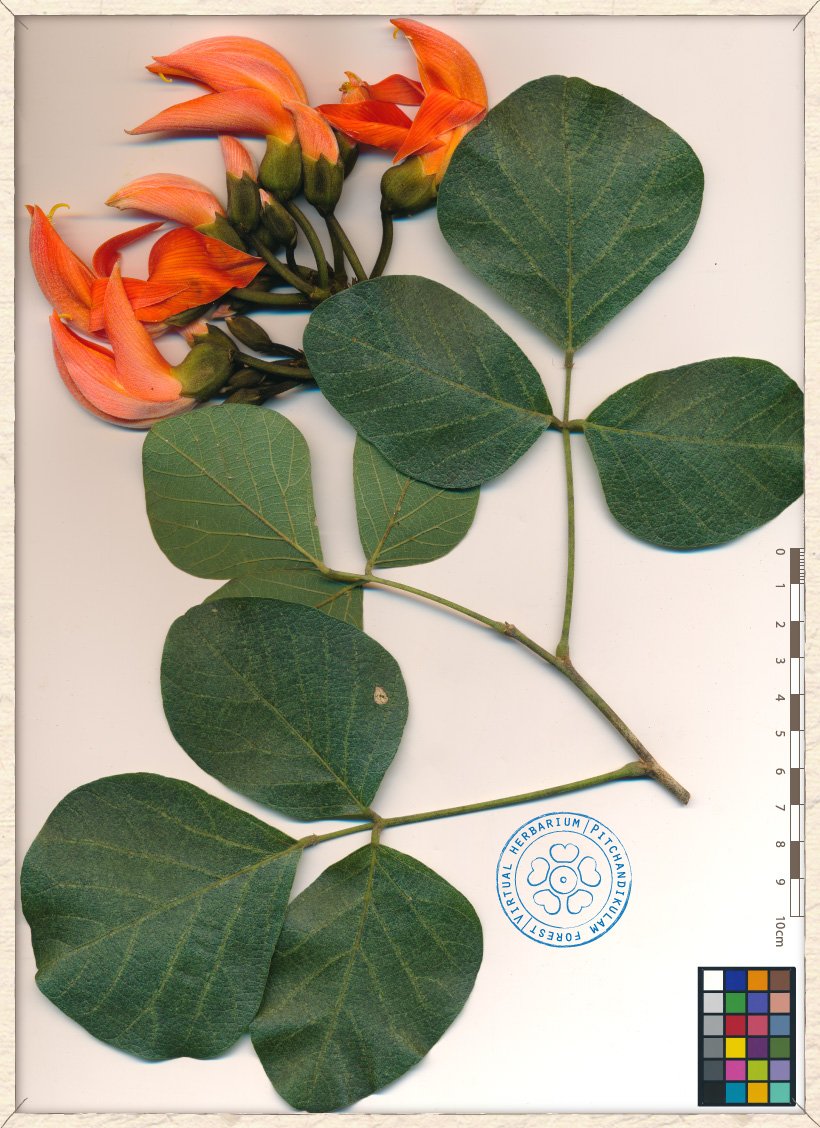
Main specimen
Habit
Butea monosperma is a medium-sized and deciduous tree growing up to 10-12 m high.
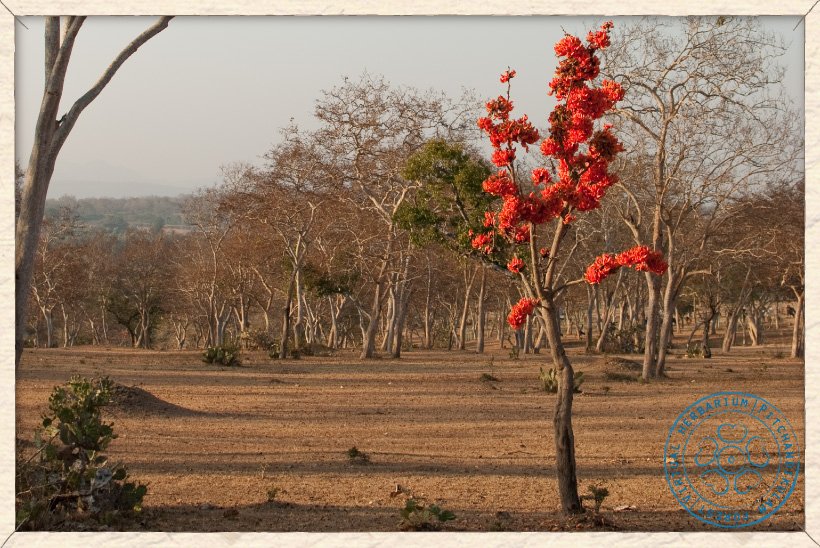
The flame of the forest…
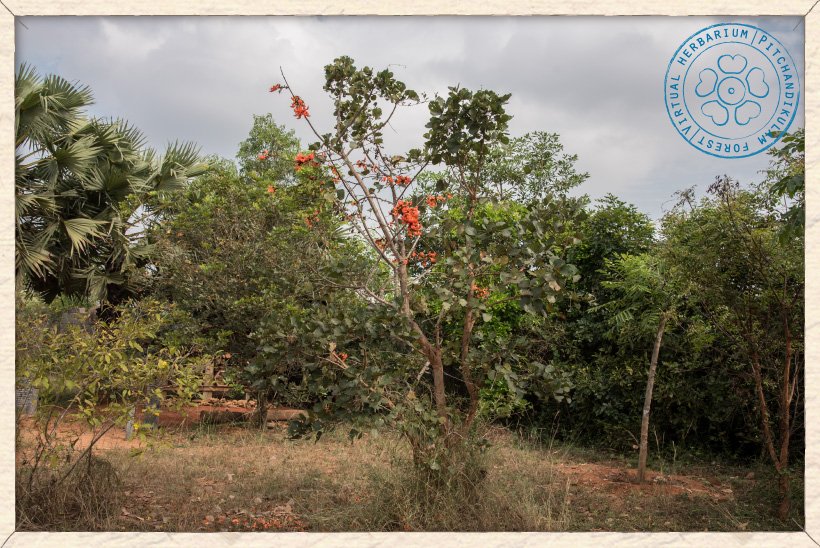
Butea monosperma young tree
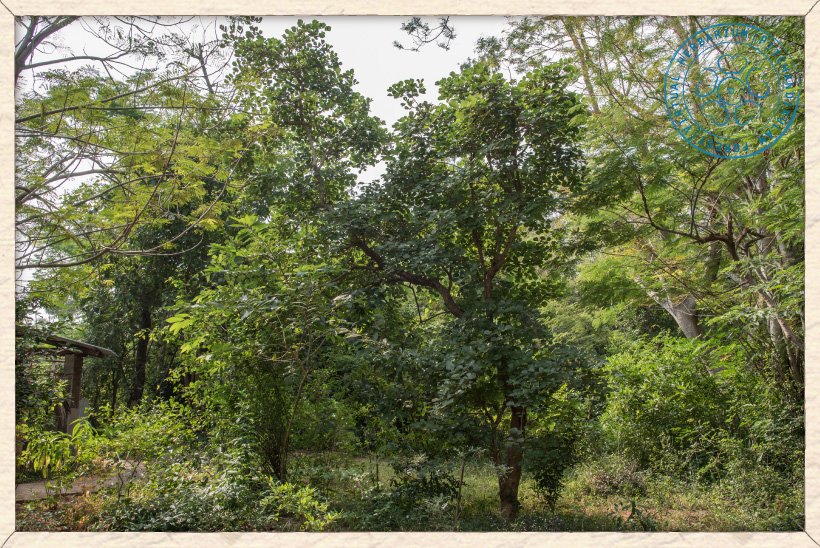
Butea monosperma tree

Butea monosperma young tree with new foliage
Stem Bark
The bark of Butea monosperma is greyish or pale brown-coloured, longitudinally fissured and transversally cracked.
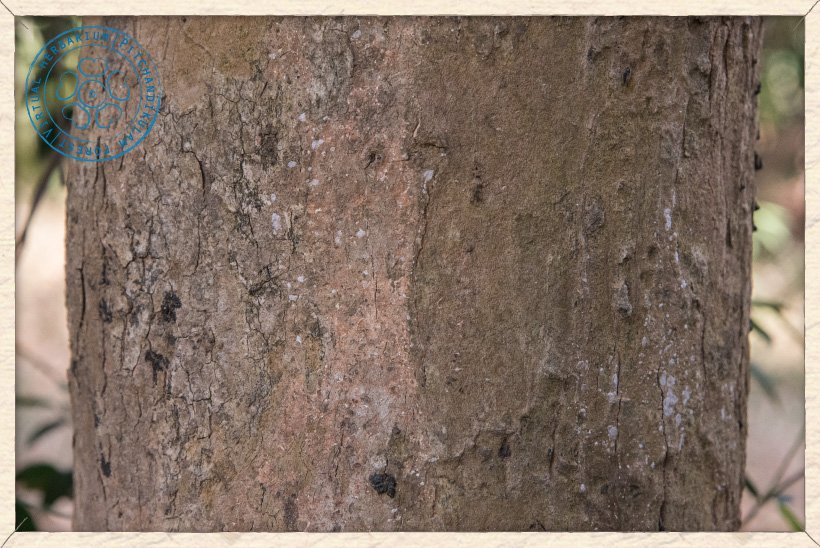
Butea monosperma trunk
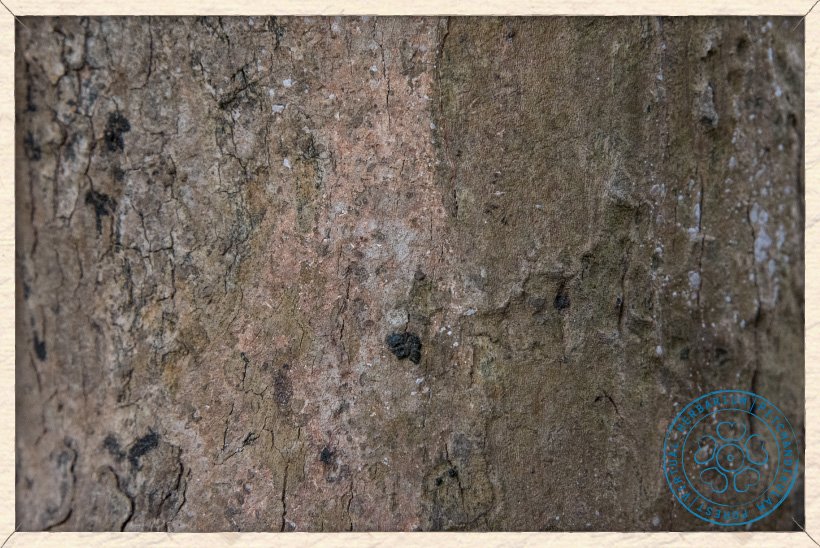
Butea monosperma bark
Leaf
The leaves of Butea monosperma grow alternately on the stem (spirally arranged).
The leaf is compound, trifoliate. The leaflets are dark green-coloured above and paler beneath. The leaf is coriaceous and pubescent on both sides.
The leaflets have a 0.8-1 cm long petiole.
The leaflet of Butea monosperma is 8-12 cm long and 6-8 cm wide. The shape of the blade is ovate, the apex is acute, the base is cuneate or oblique and the margins are entire.
The venation of the leaf is reticulate with a prominent midrib.
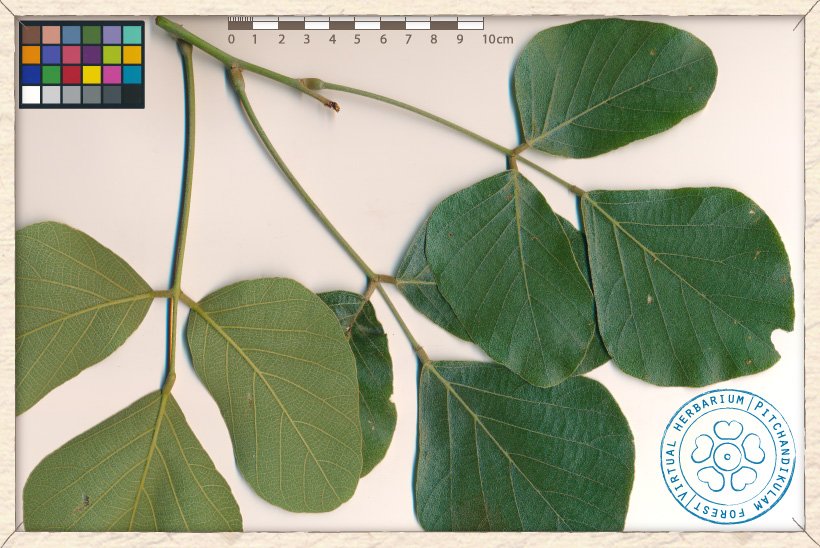
Butea monosperma leaves
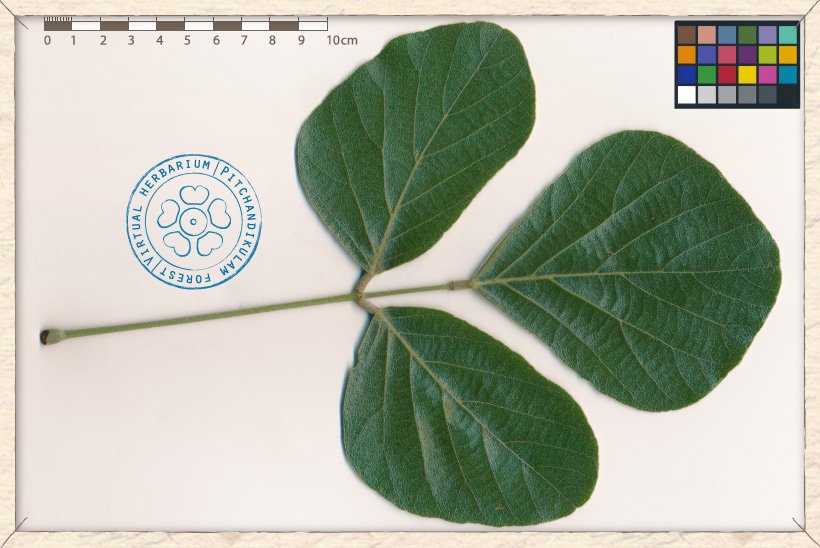
Butea monosperma leaf (upper side)
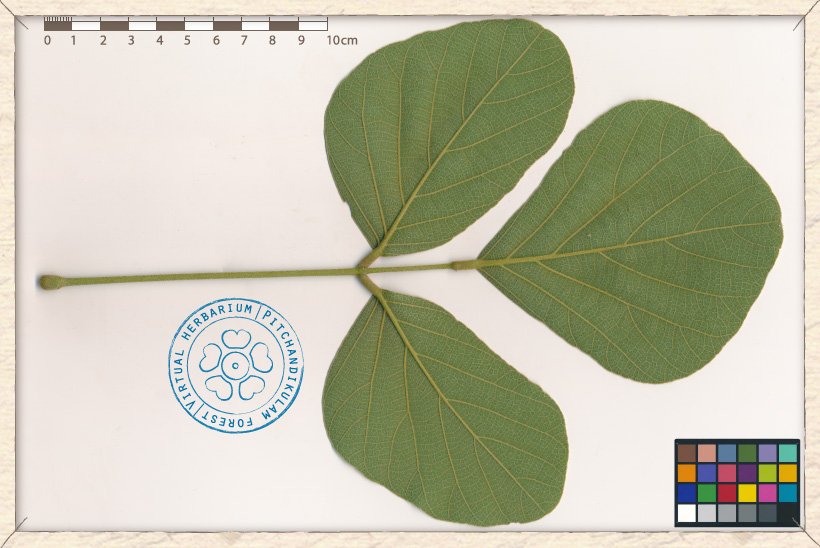
Butea monosperma leaf (lower side)
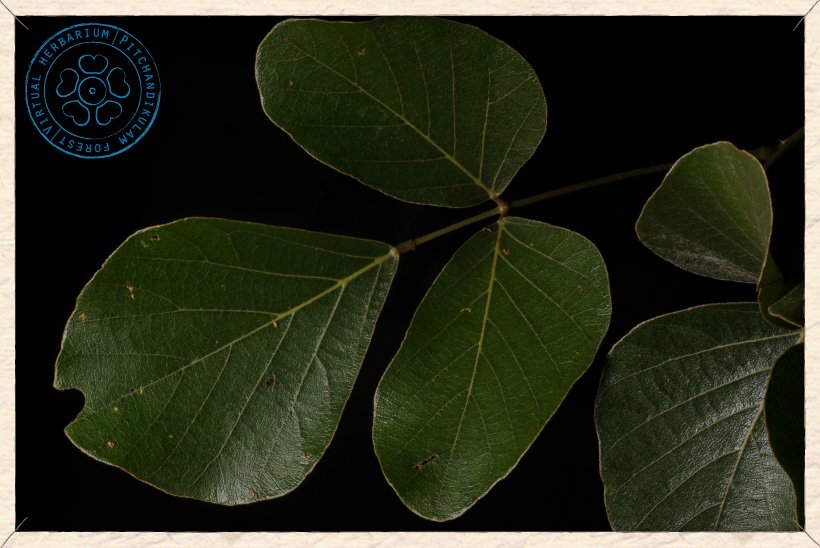
Butea monosperma compound leaf (upper side)
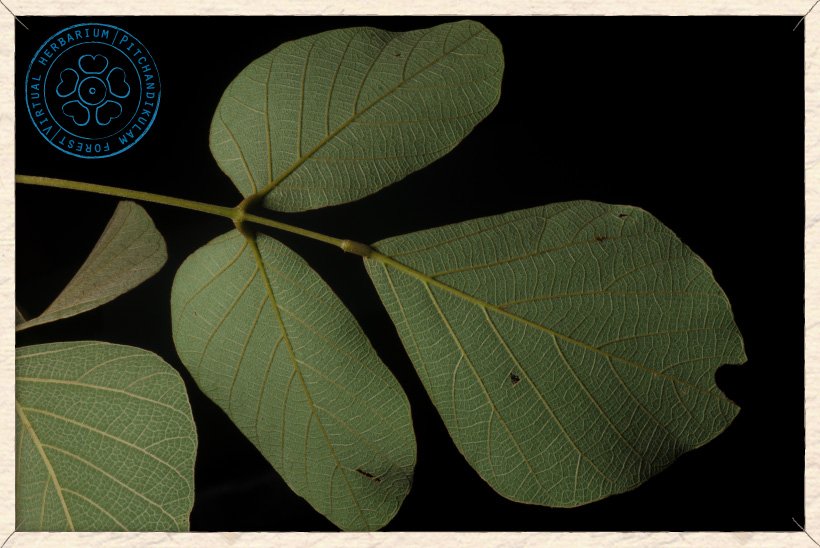
Butea monosperma compound leaf (lower side)
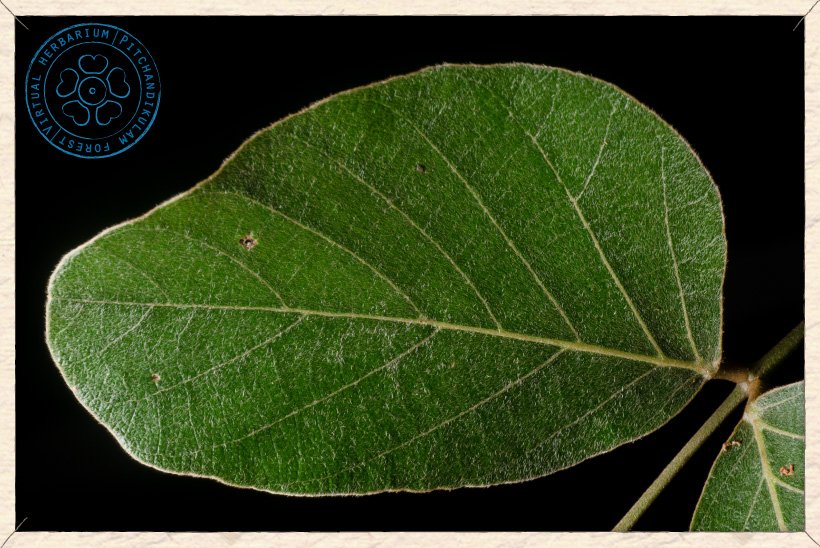
Butea monosperma leaflet (upper side)
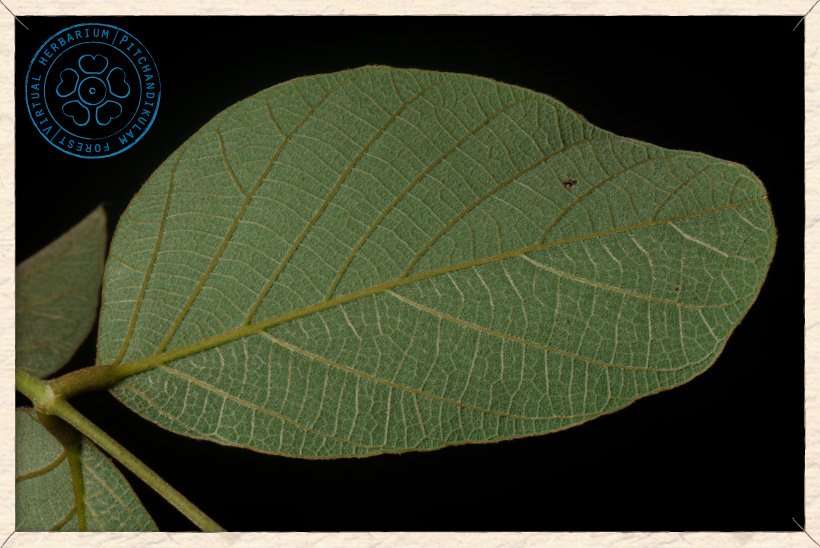
Butea monosperma leaflet (lower side)
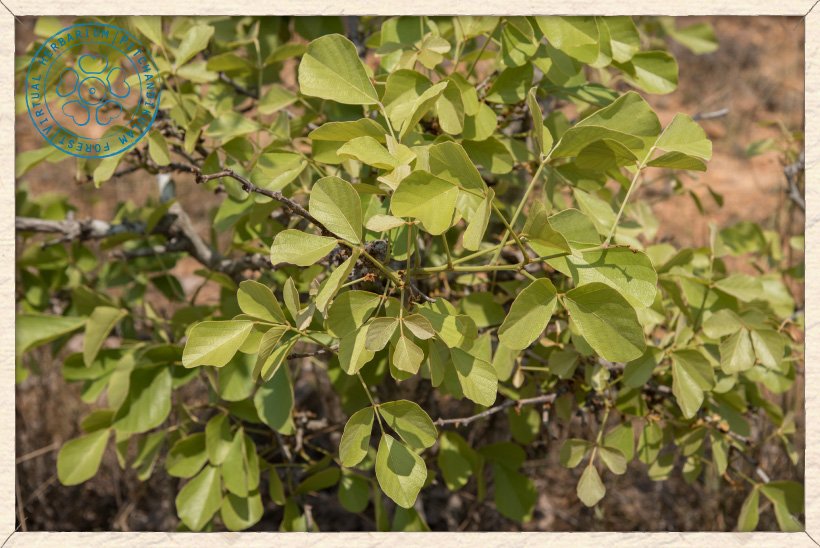
Butea monosperma new leaves
Flower
The flowers of Butea monosperma are grouped in axillary racemes (up to 40 cm long) on leafless branchlets.
The flowers have a 3-4 cm long peduncle.
The flowers are 5-merous.
The calyx-tube is campanulate, 5-lobed and 2 cm long and 1.5 cm across. The calyx is green and finely pubescent.
The corolla is composed of 5 bright orange-coloured and pubescent petals. The corolla is about 4-5 cm across.
The androecium is composed of a curved and 5-6 cm long staminal sheath with 9 free stamens (1.5-2 cm long) at the end. 1 stamen is completely free.
The pistil is composed of a curved and 4-4.5 cm long style and a simple stigma.
The ovary is oblong and about 2.5 cm long.
The buds are covered with short hairs (velvety).
The flowers are fragrant.
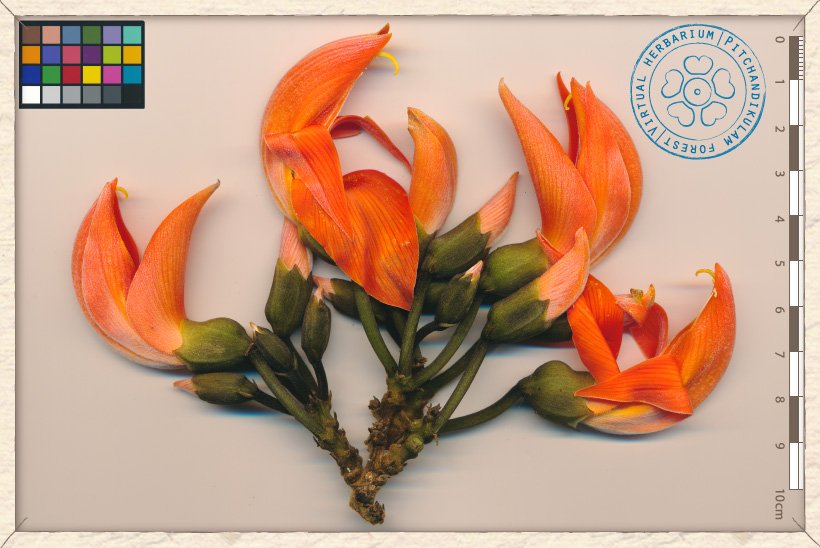
Butea monosperma inflorescences

Butea monosperma flower

Butea monosperma flower structures

Butea monosperma flower buds

Butea monosperma flower

Butea monosperma flowering branches

Butea monosperma inflorescences
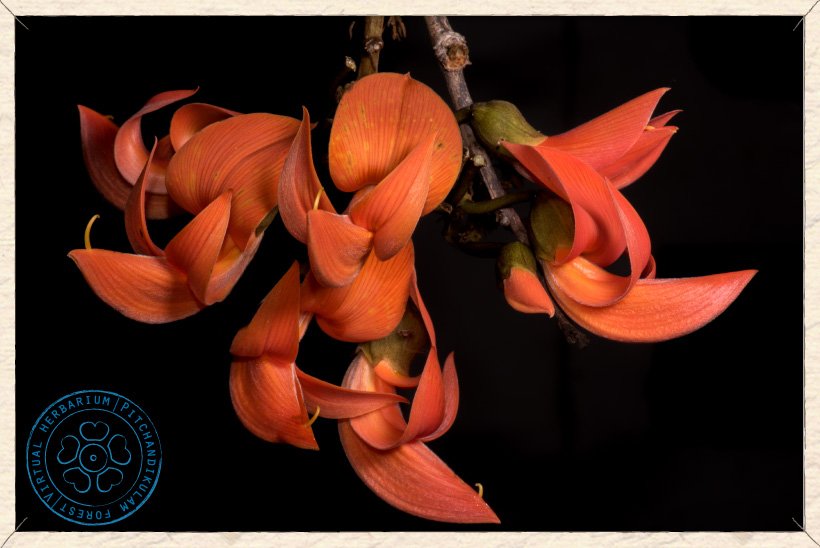
Butea monosperma flowers
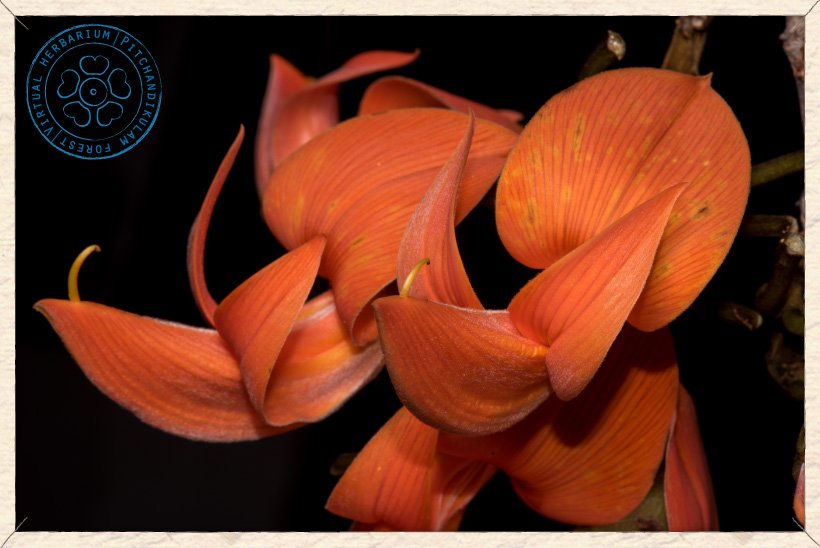
Butea monosperma flowers

Butea monosperma flower and buds
Fruit
The fruit of Butea monosperma is a flattened pod. It is velvety, 12-15 cm long and 5-6 cm wide and light brown-coloured. Each pod contains only one seed.
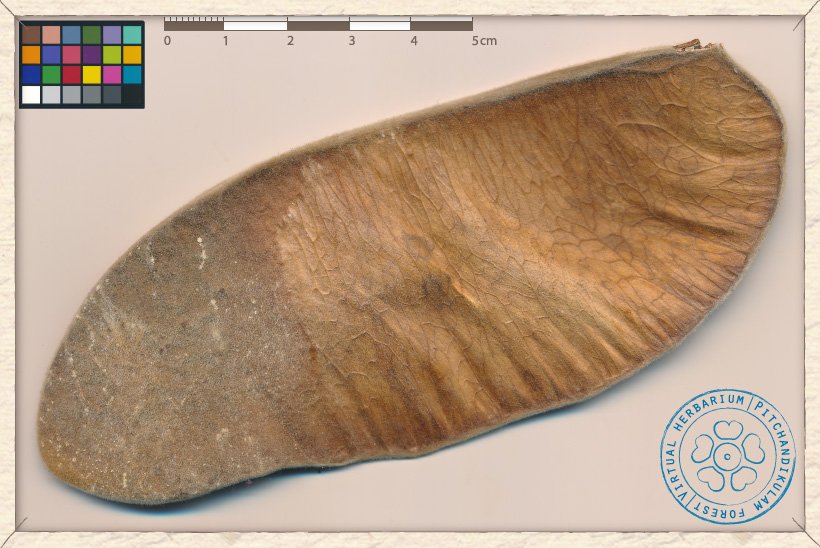
Butea monosperma pod
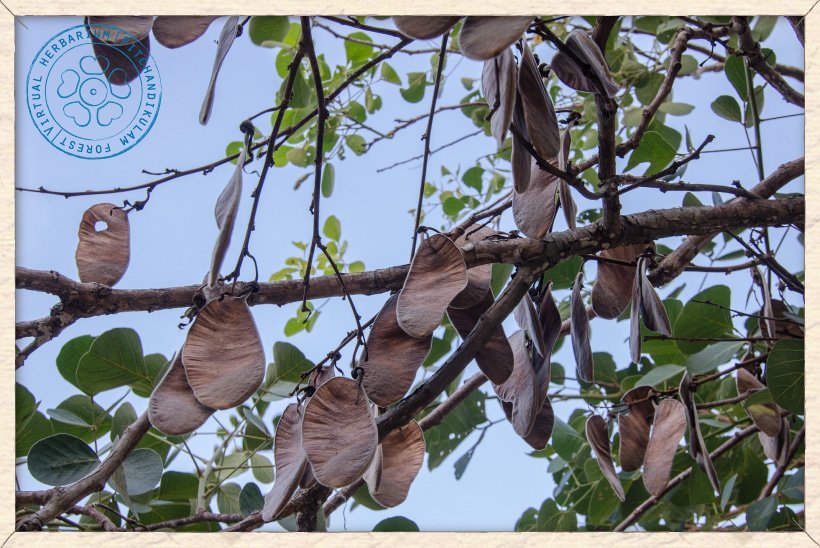
Butea monosperma fruits
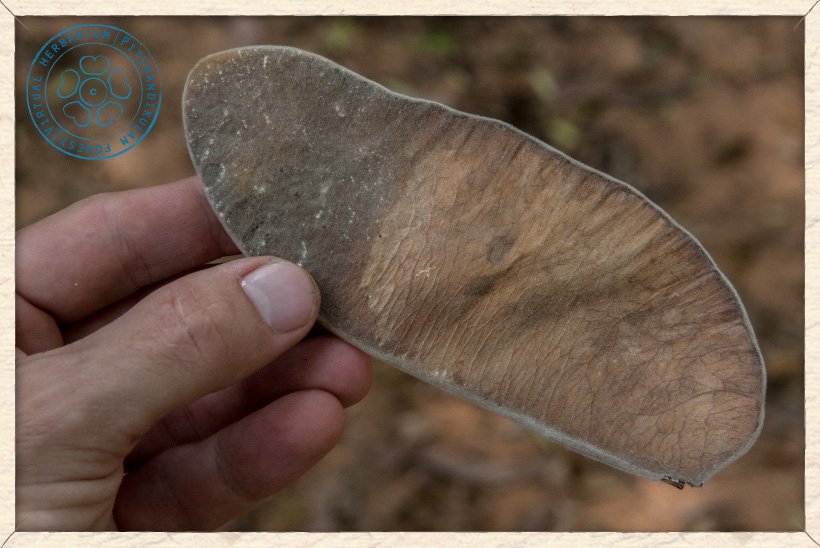
Butea monosperma pod
Seed
The seed of Butea monosperma is compressed, ellipsoid and brownish-coloured. The seed is 3-3.5 cm long and 2-2.5 cm wide. There is only one seed per pod.
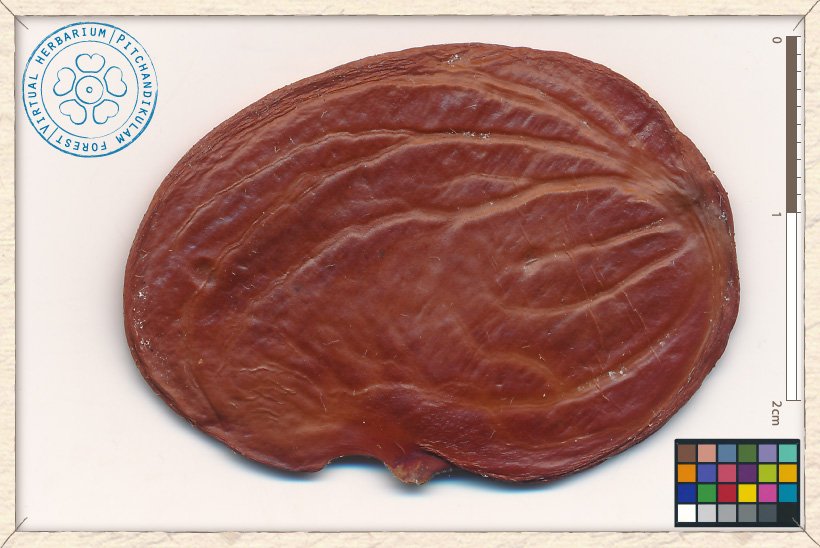
Butea monosperma seed
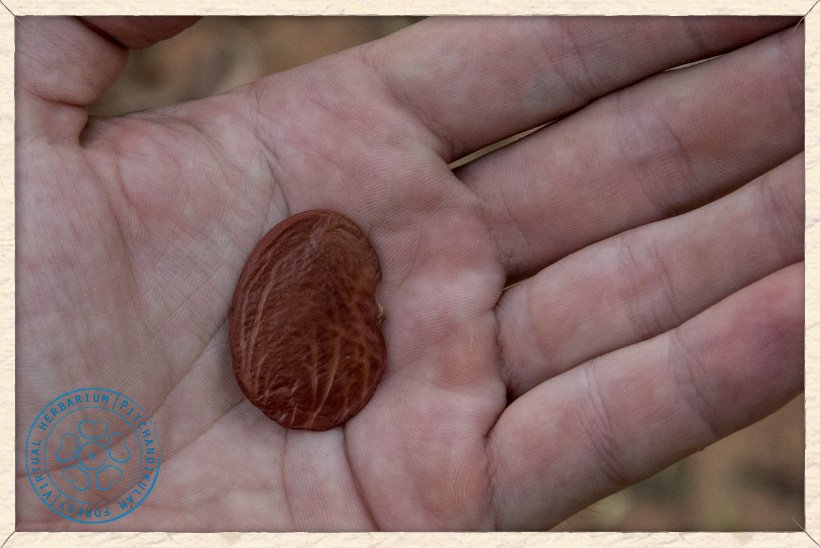
Butea monosperma seed
Human Uses
In India, the tree is an important host for the lac insect (Laccifer lacca), which produces shellac.
Source : Orwa C., Mutua A., Kindt R., Jamnadass R., Anthony S., 2009, Agroforestree Database: a tree reference and selection guide
The young leaves of Butea monosperma are a good fodder.
A fibre is obtained from the inner bark. It is used for cordage, caulking the seams of boats and making paper.
A red exudate is obtained from the bark, hardening into a gum known as "butea gum" or "Bengal kino". It is used as a dye and as tannin.
A bright yellow to deep orange-red dye, known as butein, prepared from the flowers is used especially for dyeing silk and sometimes for cotton. This dye is used by Hindus to mark the forehead.
Source : Orwa C., Mutua A., Kindt R., Jamnadass R., Anthony S., 2009, Agroforestree Database: a tree reference and selection guide
The flowers of Butea monosperma are useful in the treatment of liver disorders.
The seeds are anthelmintic.
The gum is a powerful astringent and it is applied in cases of diarrhoea.
Source : Orwa C., Mutua A., Kindt R., Jamnadass R., Anthony S., 2009, Agroforestree Database: a tree reference and selection guide
Ecology
Butea monosperma is "found throughout the drier parts of India, often gregarious in forests, open grasslands and wastelands. A characteristic tree of the plains, it often forms pure patches in grazing grounds and other open places". (Orwa C., Mutua A., Kindt R., Jamnadass R., Anthony S., 2009, Agroforestree Database: a tree reference and selection guide)
Distribution
Indian subcontinent, Myanmar, Thailand, Malaysia, Laos, Cambodia, Vietnam, Indonesia.
Source
Information on this page is sourced from: