Gunci
Abrus precatorius
Fabaceae
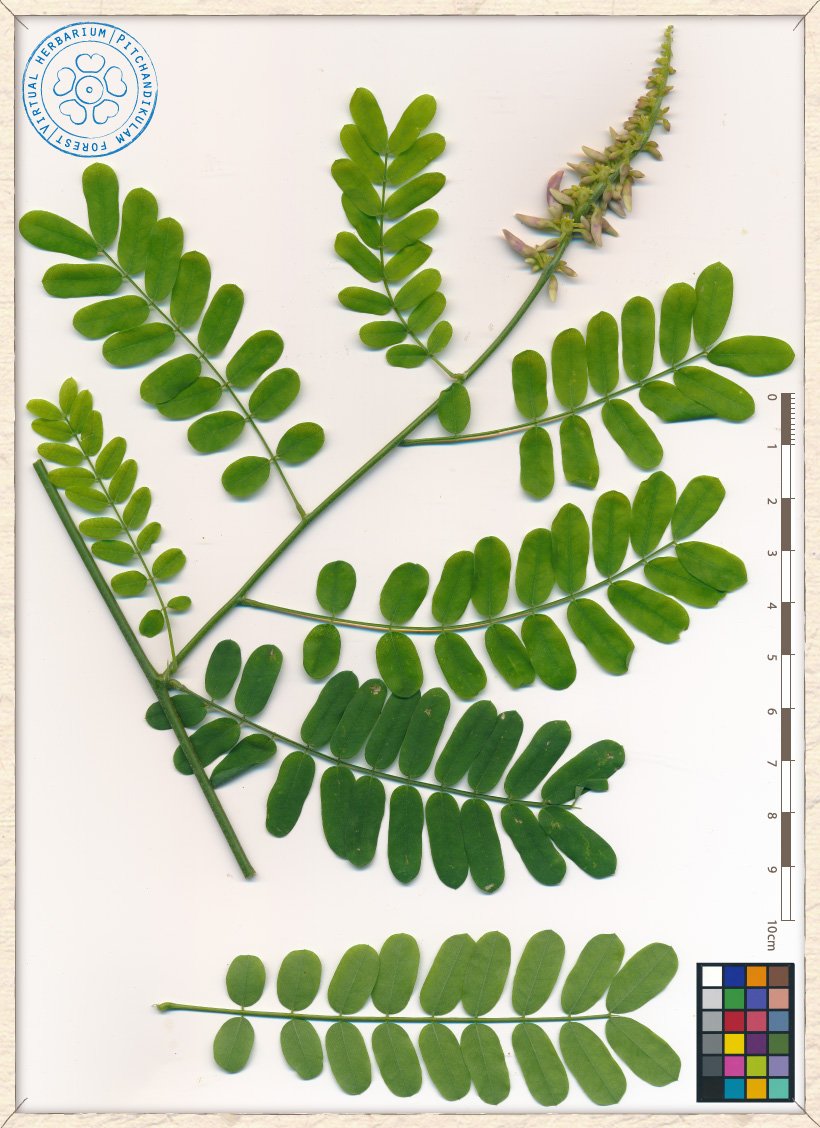
Main specimen
Habit
Abrus precatorius is a deciduous, perennial and thornless climber.
It is a high-climbing, twining, or trailing woody vine with slender herbaceous branches.

Abrus precatorius with dried pods and seeds
Stem Bark
The stems are numerous, scarcely woody, slender, glabrous and with long internodes.

Abrus precatorius twining stem

Abrus precatorius stem and bark
Leaf
The leaves are alternate, petioled (1 cm long petiole), 10-15 cm long, even-pinnately compound with 10-15 pairs of leaflets.
The leaflets are opposite, oblong, thinly membranous, slightly hairy, 1.5-2.5 long and 0.6-0.8 cm wide, with margins entire, base and apex obtuse, apex apiculate. They terminate in a bristle and they have a 1-1.5 mm long petiolule.
The rachis is thickened at the base, very slender, channeled and glabrous and ending in a spine.
At the base of a leaf, there are small, setaceous and 2.5 mm long stipules.

Abrus precatorius leaf : lower and upper sides

Abrus precatorius leaflet upper and lower sides

Abrus precatorius foliated stem

Abrus precatorius leaves

Abrus precatorius leaf
Flower
The flowers are crowded in dense clusters, terminal or axillary. They are clustered at the swollen nodes of the rachis. This pseudo-raceme is 10 cm long (shorter than leaves) and has a 3 cm long peduncle. The flowers are 1 cm across, shortly stalked (2 mm long pedicel).
The bracts are deciduous and bracteols are appressed to the calyx.
The calyx tube is narrowly campanulate, pubescent (likely silky), 2-3 mm long with a truncate apex and very short and obscure lobes.
The corolla is composed of clawed, white to pink or pale violet petals. The standard (banner) is broadly ovate, auricled, 1.5 cm long and 0.8-1 cm wide. The standard base is adherent to the staminal sheath. The wings are narrow, oblong and falcate, 0.8 cm long and 0.3-0.4 cm wide. The keels are curved, 1 cm long and 0.2-0.3 cm wide.
The stamina sheath is 8 mm long. Androecium is composed of 9 monodelphuous stamens with nearly equal filaments (2-3 mm long) and uniform anthers.
The pistil is composed of a 8 mm sub-sessile and pubescent ovary, a very short (0.5 mm) and incurved style with a capitate stigma.

Abrus precatorius terminal flowers and leaf

Abrus precatorius flowered clusters (pseudo-raceme)

Abrus precatorius buds cluster and swollen node

Abrus precatorius flowers and buds

Abrus precatorius flower

Abrus precatorius pseudo-raceme (open flowers and buds)

Abrus precatorius flowers and buds

Abrus precatorius flowers and buds clusters

Abrus precatorius flowers (with visible stamens inside)
Fruit
The fruit is a short, oblong, pilose (finely silky), winkled and thick pod, 3-4 cm long and 1-1.5 cm wide. It is turgid with a sharp deflexed beak.
This pod splits before falling to reveal the seeds.

Abrus precatorius ripe pods

Abrus precatorius unripe pods

Abrus precatorius unripe fruits and flowers

Abrus precatorius unripe fruits and flowers

Abrus precatorius fruits

Abrus precatorius mature pod revealing the seeds
Seed
There are 3-8 polished and hard seeds in a pod.
The seeds are nearly globose, 6-7 mm long, scarlet coloured with black lateral spot at the base (around the hilum).
Sometimes the seeds are black with a white eye and more rarely pure white.

Abrus precatorius seeds

Abrus precatorius seeds

Abrus precatorius seeds attached to open and dried pods

Abrus precatorius seeds attached to open and dried pods

Abrus precatorius seeds

Abrus precatorius showy seeds
Human Uses
The oil made from Abrus precatorius seeds is sometimes used as an ingredient in Indian hair products.
The seeds were used by jewellers as a unit of weight. The unit is known as ratti (the weight of one seed = 1 ratti and 8 ratti = 1 Gram). Formerly, Indians used this measure to weigh gold.
The finely powdered seeds are used by jewellers to increase adhesion when soldering delicate ornaments.
The seeds are used for making bracelets, necklaces, rosaries, etc.
The fibre extracted from the stem is woven into baskets.
Source
Information on this page is sourced from: