Carissa spinarum
No common name set
EditApocynaceae
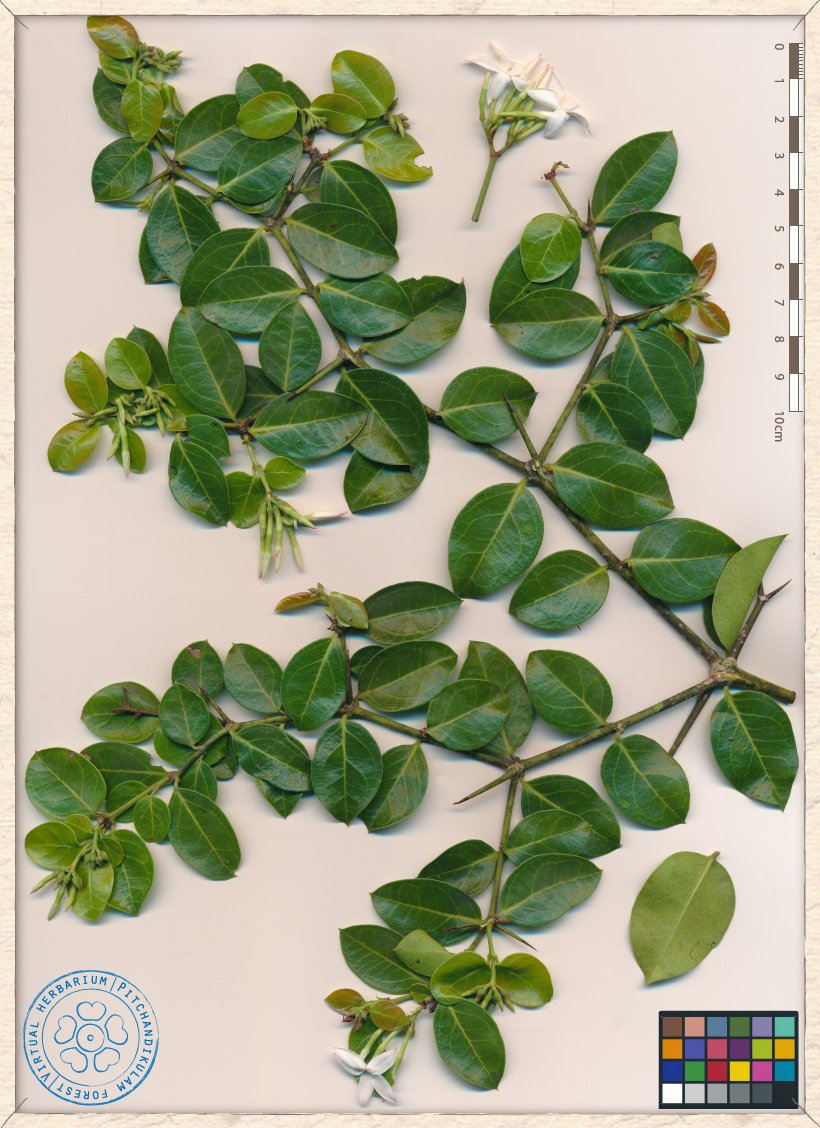
Main specimen
Habit
Carissa spinarum is an evergreen shrub, up to 4 m. This shrub is thorny, erect and scrambling (for this reason it is often describe as a climber). Carissa spinarum is armed with straight woody spines often in pairs and it has a milky latex.

Carissa spinarum shrub

Carissa spinarum young shrub

Carissa spinarum branch
Stem Bark
The bark of Carissa spinarum is brown, rough with scales. It is smooth and green on young stems. Carissa spinarum has 3-4 cm long and opposite spines. The thorns are sometimes forked.

Carissa spinarum thorns

Carissa spinarum stem

Carissa spinarum forked thorn
Leaf
The leaves of Carissa spinarum grow opposite on the stem.
The leaf is simple, bright green coloured above and paler beneath. The leaf is shiny, coriaceous and glabrous on both sides.
The leaves have a 2 mm long petiole.
The leaf of Carissa spinarum is 3-5 cm long and 2-3 cm wide. The shape is ovoid-ovate, the apex is acuminate (sometimes with a short bristle), the base is cuneate or rounded and the margins are entire.
The venation of the leaf is reticulate with a prominent midrib.

Carissa spinarum branchlet

Carissa spinarum leaf (upper side)

Carissa spinarum leaf (lower side)

Carissa spinarum leaf (upper side)

Carissa spinarum leaf (lower side)

Carissa spinarum branchlet

Carissa spinarum foliage
Flower
The flowers of Carissa spinarum are grouped in terminal or axillary cymes. The pedicel of the flowers is short (less than 2 mm long).
The calyx is composed of 5 sepals. The calyx-lobes are 2 mm long and 1.5 mm wide, they are ovate with acute-acuminate apex. The calyx is pubescent and light green coloured.
The corolla is composed of 5 white coloured (sometimes pinkish at the apex) and glabrous petals. The corolla tube is 1.5 cm long and 2 mm in diameter and light green coloured. The corolla lobes are ovate with acuminate apex, 1.2 cm long and 5 mm wide, white coloured.
The androecium is composed of 5 stamens.
The pistil is composed of a 4 mm long style and a forked stigma. The flowers are fragrant.

Carissa spinarum inflorescence

Carissa spinarum cyme

Carissa spinarum cyme

Carissa spinarum flower (upper side)

Carissa spinarum flower (lower side)

Carissa spinarum flower buds

Carissa spinarum flowers

Carissa spinarum flower

Carissa spinarum flower buds

Carissa spinarum in bloom
Fruit
The fruit of Carissa spinarum is a berry. The fruit is ovoid-ellipsoid, 1 cm long and 8 mm wide. The berry is green, reddish and finally purplish black when ripe. It contains usually 4 seeds.

Carissa spinarum unripe

Carissa spinarum unripe

Carissa spinarum ripe

Carissa spinarum unripe

Carissa spinarum unripe

Carissa spinarum ripe
Seed
The seeds of Carissa spinarum are ellipsoid and compressed. They are light brown, 6 mm long and 5 mm wide. There are usually 4 seeds in a berry.

Carissa spinarum seeds

Carissa spinarum seeds
Human Uses
The roots of Carissa spinarum are ground and put into the wounds of cattle to kill worms.
Source : Chopra, 1956, Glossary of Indian medicinal plants
The fruits of Carissa spinarum are edible, but only when fully ripe. The black berries have a sweet flavour but the milky sap of this plant is poisonous (as typical for the Apocynaceae).
In traditional medicine Carissa spinarum is used as a diuretic, purgative, antiviral, antibacterial, antiplasmodial, febrifuge, hypotensive, antioxidant and cardiotonic.
The branches and leaves decoction are used for headache, chest pains, rheumatism, syphilis, dysentery and fever.
The boiled root extract is drunk for chest pain, indigestion, diarrhea, typhoid fever, nose bleeding, lower abdominal pains in pregnant mothers, headache and fever in children. (Quattrocchi, 2012, CRC World Dictionary of Medicinal and Poisonous Plants)
The juice of the fresh plant is used for infected wounds that refuse to heal. The Ayurvedic Pharmacopoeia of India indicated the stem bark in obstinate skin diseases and the root in urinary disorders. (Khare, 2007, Indian Medicinal Plants, An Illustrated Dictionary)
The roots are used to treat mouth ulcers.
Ecology
In india, Carissa spinarum is found in deciduous forests and scrub jungles from the coastal plains up to 1000 m in the hills.
Carissa spinarum is most often found in semiarid coastal regions on fine-textured soils such as clays and clay-loams. In more arid regions the plant tends to be confined to areas of higher moisture such as at the base of hills or floodout areas. But it has a high ecological tolerance and can live in a wide range of habitats (https://en.wikipedia.org/wiki/Carissa_spinarum).
Distribution
Carissa spinarum is widely distributed in tropical regions of Africa, Southern Asia, Australia, and various islands of the Indian Ocean.
Source
Information on this page is sourced from: