Ficus amplissima
No common name set
EditMoraceae
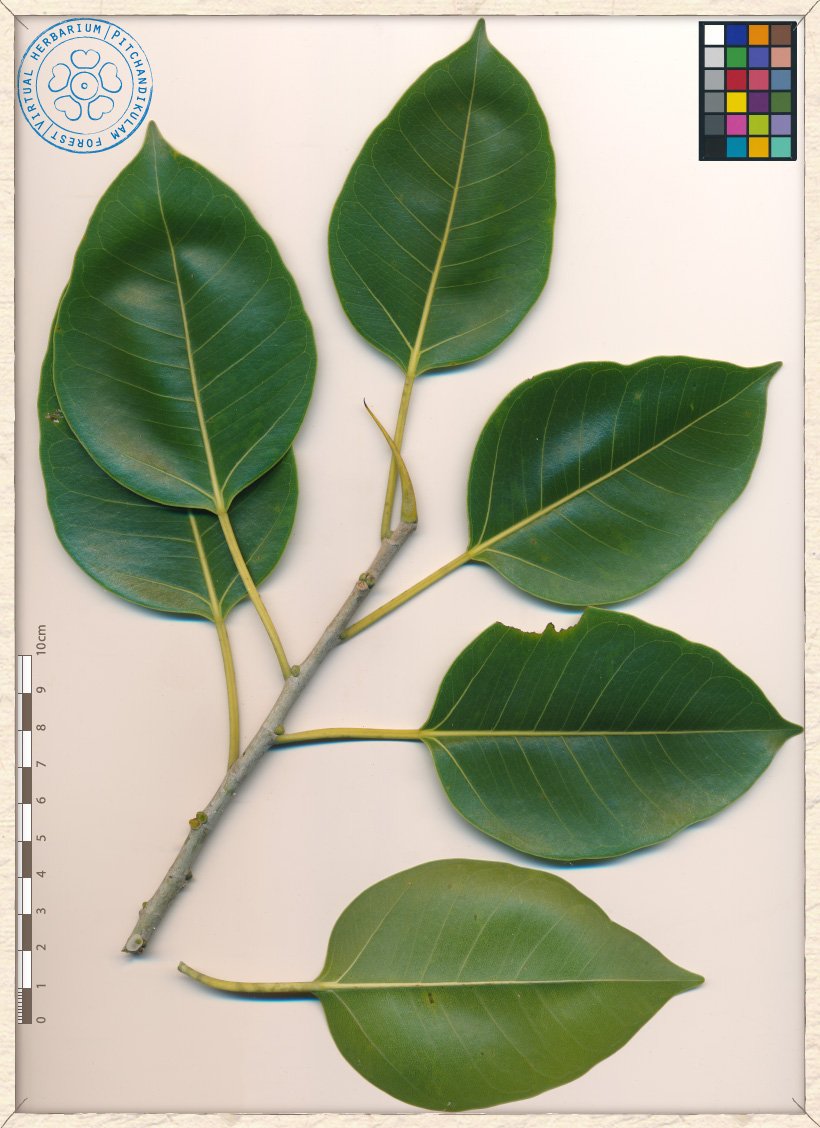
Main specimen
Habit
Ficus amplissima is a thornless and large deciduous tree growing up to 20 m. It has a spreading crown and few aerial roots.

Ficus amplissima tree

Ficus amplissima young tree
Stem Bark
The bark of Ficus amplissima is dark grey or brown with a smooth surface and with numerous transversal lenticels.

Ficus amplissima trunk

Ficus amplissima bark
Leaf
The leaves of Ficus amplissima grow alternately on the stem (spirally arranged).
The leaf is simple, bright green-coloured above and paler beneath. The leaf is coriaceous and glabrous on both sides.
The leaves have a 4-5 cm long and pubescent petiole.
The leaf blade is 8-12 cm long and 5-8 cm wide. The shape of the blade is ovate, the apex is acuminate, the base is rounded and the margins are entire.
The venation of the leaf is reticulate with a prominent midrib.

Ficus amplissima twig

Ficus amplissima leaf (upper side)

Ficus amplissima leaf (lower side)

Ficus amplissima leaf and figs

Ficus amplissima leaf (upper side)

Ficus amplissima leaf (lower side)
Flower
The flowers of Ficus amplissima are enclosed within a fleshy receptacle referred to as the fig. What we think of as a fruit is an inflorescence, a flower-bearing structure called syconium (*).
The syconium of Ficus amplissima is monoecious, containing both female and male flowers and also gall flowers (hosts of pollinators).
(*) The syconium is an urn-shaped receptacle which contains between 50 to 7000 (depending on the species) highly simplified uniovulate flowers or florets on its inner surface. It is closed off from most organisms by the ostiole, formed by bracts.
Syconia can be monoecious or functionally dioecious : the former contain female flowers with variable style length and few male flowers, and produce seeds and pollen. The latter have male and female forms in different plants : seed figs contain female flowers with long styles and produce seeds; gall figs contain female flowers with short styles and male flowers and produce pollen.
Once pollinated, the florets develop into achenes or drupes, in which the seeds are enclosed by a layer of endocarp. From this perspective, the fig is an enclosure with tens to thousands of fruits within it. (Galil, J., Fig biology, 1977)

Ficus amplissima inflorescence : longitudinal section of the syconium enclosing the flowers

Ficus amplissima flowers

Ficus amplissima inflorescence (longitudinal section of the syconium enclosing the flowers)

Ficus amplissima inflorescence (longitudinal section of the syconium enclosing the flowers)
Fruit
The fig, what we referred to as a fruit, is in fact a fleshy enclosure, an infructescence that contains hundreds of tiny fruits (achenes).
The fruits of Ficus amplissima are globose and smooth achenes, brownish and about 1 mm across.
The figs are sessile, in pairs at the axil of the leaves.
They are 1.3-1.5 cm across, depressed-globose, downy and they are dark purple when ripe.

Ficus amplissima infructescences : the figs (unripe)

Ficus amplissima unripe figs

Ficus amplissima ripe figs

Ficus amplissima unripe figs

Ficus amplissima ripe figs

Ficus amplissima unripe figs
Human Uses
The wood of Ficus amplissima has a hard, straight grain with a smooth surface. It is an attractive wood for good quality decorative woodwork.
Source : Howard, 1948, A Manual of the Timbers of the World: Their Characteristics and Uses
The pounded bark of Ficus amplissima is used in stomachache
and gastric disorders.
The latex is used to increase lactation in women.
Source : Quattrocchi, 2012, CRC World Dictionary of Medicinal and Poisonous Plants
Ecology
Ficus amplissima grows in deciduous and semi-evergreen forests, from coastal plains up to 1200 m.
The species tolerates poor soils but it thrives in well-drained, rich soils and sunny places.
Distribution
Peninsular India, Sri Lanka and Maldives
Source
Information on this page is sourced from: