Alangium salviifolium
Cornaceae
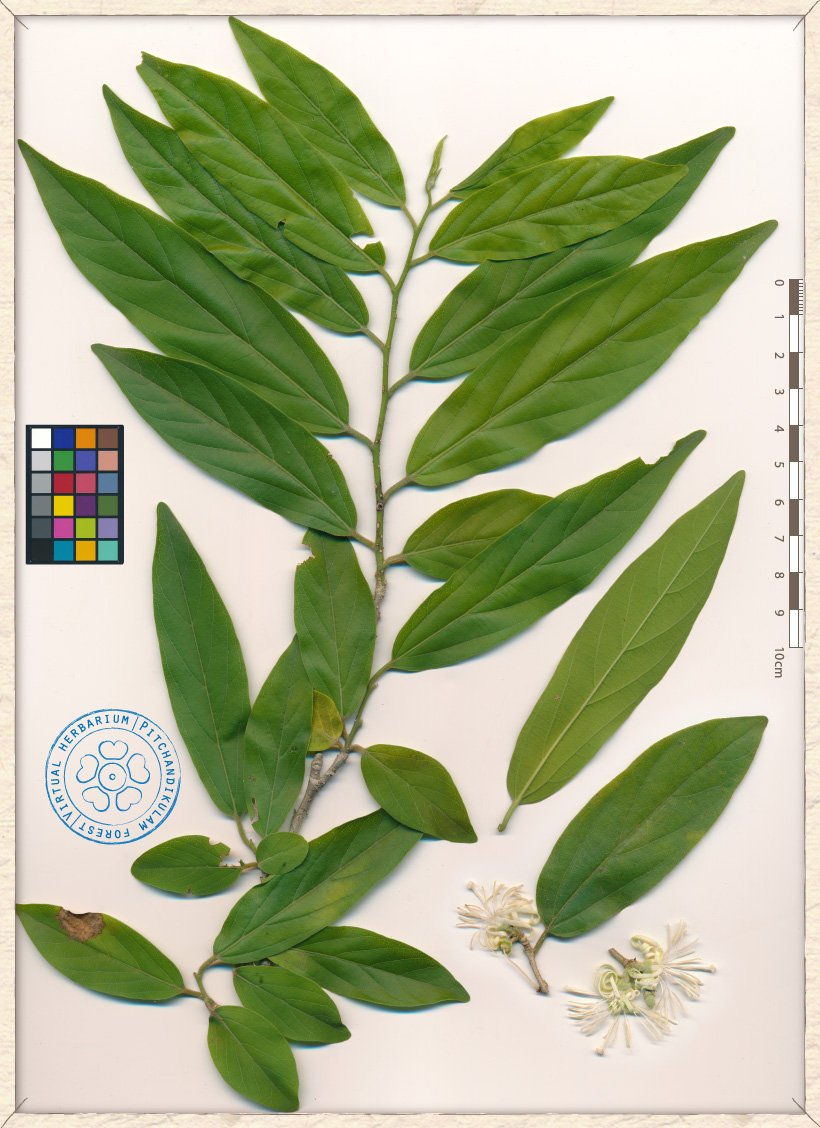
Main specimen
Habit
Alangium salviifolium is a medium-sized, thornless and deciduous tree growing up to 10-12 m high.

Alangium salviifolium young tree

Alangium salviifolium foliage
Stem Bark
The bark of Alangium salviifolium is rough, grey-coloured and longitudinally fissured.

Alangium salviifolium trunk

Alangium salviifolium bark
Leaf
The leaves of Alangium salviifolium grow alternately on the stem (spirally arranged).
The leaf is simple, bright green-coloured above and paler beneath. The leaf is chartaceous and glabrous on both sides (pubescent on the veins on both sides).
The leaves have a 1 cm long petiole.
The leaf of Alangium salviifolium is 10-15 cm long and 3-4 cm wide. The shape of the blade is lanceolate, the apex is acute, the base is rounded and the margins are entire.
The venation of the leaf is reticulate with a prominent midrib.

Alangium salviifolium twig (upper side)

Alangium salviifolium twig (lower side)

Alangium salviifolium leaf (upper side)

Alangium salviifolium leaf (lower side)

Alangium salviifolium leaves

Alangium salviifolium leaf (upper side)

Alangium salviifolium leaf (lower side)

Alangium salviifolium branchlets
Flower
The flowers of Alangium salviifolium are grouped in short axillary cymes.
The flowers are 5-merous.
The calyx-tube is urn-shaped, 1-2 mm long with triangular lobes up to 1.5 mm long. The calyx is light green and tomentose.
The corolla is composed of 10 cream-coloured,reflexed and strap-shaped petals. The petals are densely tomentose outside and glabrous inside, 1-1.5 cm long and 2 mm wide.
The androecium is composed of 10-30 stamens. The filaments are 5-10 mm long.
The style is 1.5-2 cm long style with a capitate stigma at the end.
The ovary is turbinate and 1-celled.
The flowers are fragrant.

Alangium salviifolium inflorescence

Alangium salviifolium flower

Alangium salviifolium flower and flower bud

Alangium salviifolium flower structures

Alangium salviifolium flower buds

Alangium salviifolium flower

Alangium salviifolium inflorescence

Alangium salviifolium flower and flower bud

Alangium salviifolium flowering branchlets

Alangium salviifolium in bloom
Fruit
The fruit of Alangium salviifolium is an ellipsoid drupe. It is about 2 cm long and 1 cm wide, pubescent and purple-coloured when ripe. The fruit contains one seed.
Human Uses
The twigs are used for brushing the teeth in India.
A mixture of mature fruits of Alangium salviifolium with honey and rootstocks of sweet flag (Acorus calamus) is used to manage pests on agricultural crops.
Source : Ebanyenle, E., 2009. Alangium salviifolium (L.f.) Wangerin. In: Lemmens, R.H.M.J., Louppe, D. & Oteng-Amoako, A.A. (Editors). Prota 7(2): Timbers/Bois d'oeuvre. PROTA, Wageningen, Netherlands.
The wood of Alangium salviifolium is valued for musical instruments and furniture. It is used in building as beams, for flooring, furniture, cabinet work, inlaying, carving, bobbins, spindles, shuttles, rice pestles, tool handles, walking sticks, gunstocks and handicraft articles.
Source : Ebanyenle, E., 2009. Alangium salviifolium (L.f.) Wangerin. In: Lemmens, R.H.M.J., Louppe, D. & Oteng-Amoako, A.A. (Editors). Prota 7(2): Timbers-Bois d'oeuvre. PROTA, Wageningen, Netherlands.
The leaves are used to cure asthma and as cataplasm to reduce rheumatic pains.
The fruit is cooling, tonic, nutritive, useful in burning of the body, consumption, and in haemorrhage.
The fruit is used as purgative, expectorant, carminative and as an antidote for poisoning. It was also used in leprosy.
The fruit juice is applied to cure eye diseases.
The stem is used to cure diarrhoea and vomiting.
The roots and the fruits are used for the treatment of rheumatism and haemorrhoid.
The root bark is also used in skin problems and as an antidote for snake bite. It is also used to expel parasitic worms and other internal parasites from the body. It is also used as an emetic and purgative.
Sources :
- Basu & Kirtikar, 1918, Indian Medicinal Plants
- Ebanyenle, E., 2009. Alangium salviifolium (L.f.) Wangerin. In: Lemmens, R.H.M.J., Louppe, D. & Oteng-Amoako, A.A. (Editors). Prota 7(2): Timbers-Bois d'oeuvre. PROTA, Wageningen, Netherlands.
Ecology
Alangium salviifolium is usually found near sandy riverine tracts, by the side of roads, on tank bunds, or on agricultural boundaries.
Distribution
Southern and Eastern Asia, tropical Australia, western Pacific Ocean islands and New Caledonia, western Africa and Madagascar.
Source
Information on this page is sourced from: